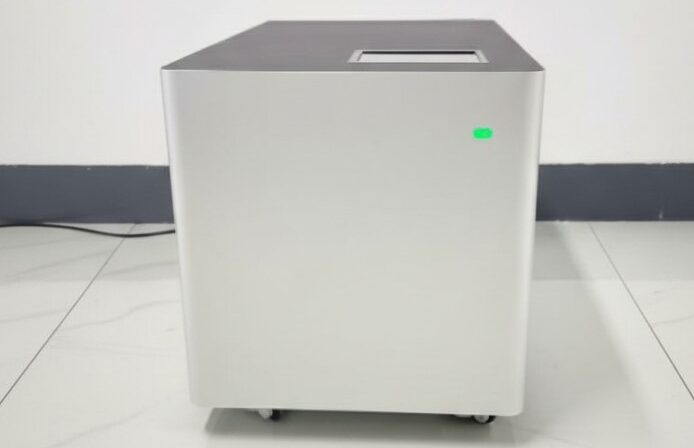
A combination of ion-ion interaction chromatography and a compact mass spectrometer presents a cost effective and powerful analysis system for the detection and quantification of amino acids in complex mixtures without the need for extra sample processing steps such as derivatizations.
Direct Analysis of Liquids and Solids
Direct sample analysis of liquids, solids and powders without chromatography is as easy as it sounds, and provides mass spectral information within seconds. The video demonstrates analysis of a reaction mixture.
Environmental Analysis
Quantitation of Perchlorate by Ion Chromatography with Suppressed Conductivity on the expression CMS
Perchlorate is a synthetic chemical that is used in the manufacture of rocket fuel, fireworks, flares and explosives, and can also be present in bleaches and some fertilizers [1]. The EPA has devised drinking water regulations for Perchlorate to minimize its impact on human health and the environment.
Achieving lower analytical detection limits for Perchlorate in environmental matrices such as drinking water allows regulatory bodies like the EPA make better informed decisions on the degree of contamination of an environmental system, as well as the remedial actions required to limit adverse health and environmental effects.
The expression Compact Mass Spectrometer (CMS) provides lower detection limits and greater selectivity for Perchlorate compared to a conductivity detector (CD). The typical detection limit of a CD is in the mid to high-ppb range, the CMS can detect < 20 ppt.
Analysis of Two Reaction Products by Direct Analysis Probe on a Compact Mass Spectrometer
The expression® CMS provides essential compound information quickly and improves the chemist’s workflow. The Atmospheric Solids Analysis Probe (ASAP®) permits fast analysis of solid and liquid samples and is a simple, low cost alternative to LC/MS methods. This direct analysis probe method has been shown to be useful for the analysis of volatile and semivolatile compounds. ASAP® is available as a combined ASAP-APCI source, or existing APCI sources can be easily modified to become dual APCI-ASAP capable.
Register to download the full application note.
Reaction Monitoring by Direct Analysis Probe on a Compact Mass Spectrometer
The expression CMS provides essential compound information quickly and improves the chemist’s workflow. The Atmospheric Solids Analysis Probe (ASAP®) permits fast analysis of solid and liquid samples and is a simple, faster and lower cost alternative to LC/MS methods. This direct analysis probe method has been shown to be useful for the analysis of volatile and semivolatile compounds. ASAP is available as a combined ASAP-APCI source, or existing APCI sources can be easily modified to become dual APCI-ASAP capable.
Register to download the full application note which includes the results of an example analysis.
University of Loughborough, Centre for Analytical Sciences

Q: WHAT IS THE FOCUS OF YOUR LAB’S RESEARCH?
A: My group specializes in developing new methods for pharmaceutical, metabolomic and security applications. In particular, this has involved the analysis of volatiles, either by direct analysis of breath, or through using thermal desorption to extract volatiles from solid or liquid matrices.
Q: WHAT WAS YOUR PREVIOUS WORK FLOW OR CHALLENGES?
A: Previously, we used a quadrupole time-of-flight instrument for volatile analysis. These instruments are not really designed with the analysis of small volatiles in mind and required preconcentration for breath analysis.
Q: WHY DID YOU INCORPORATE THE EXPRESSION CMS INTO YOUR LABORATORY?
A: The expression CMS offers excellent performance in the low m/z range and proved highly sensitive for determining volatile species in breath, requiring no preconcentration. Secondly, the instrument is transportable and can be deployed at the site of sampling giving high sample throughput and real-time measurements.
Q: WHO WOULD YOU RECOMMEND TO PURCHASE THE EXPRESSION CMS?
A: Anyone interested in volatile analysis would find the CMS an excellent instrument for targeted analysis.
Protein Analysis
Via Direct Injection using a Compact Mass Spectrometer with extended mass range (CMSL)
The CMSL is a high performance, easy to use, single quadrupole mass spectrometer with an extended mass range analysis capability to m/z 2000 — ideal for large molecule applications such as the analysis of proteins. Its small footprint makes it the instrument of choice for space-restricted laboratories and is more affordable than comparable MS systems. The CMSL brings the analytical benefits of mass spectrometry to more scientists than ever before.
Register to download the application note and see how direct injection with the expression CMSL is a fast, powerful, yet simple tool to determine, confirm or characterize the mass of a relatively pure protein analyte.
LC/MS Analysis of Proteins
Using the expression CMSL compact mass spectrometer
The CMSL is a high performance, easy to use, single quadrupole mass spectrometer with an extended mass range analysis capability to m/z 2000 — well-suited for large molecule applications such as the analysis of proteins. Its small footprint makes it the instrument of choice for space-restricted laboratories and it is more affordable than comparable MS systems. The CMSL brings the analytical benefits of mass spectrometry to more scientists than ever before.
Register to download the application note and see how LC/MS analysis using the expression CMSL and a denaturing solvent phase is a powerful tool in the analysis of protein mixtures and antibodies.
Reach Separations, United Kingdom

Q: What is the focus of your lab’s research?
A: Reach Separations is a contract research organization that services chemical, agricultural, pharmaceutical and academic clients.
Capability developed around expertise in separation science, specifically purification/prep.
Q: What previous workflow challenges did you experience?
A: Needed a tool to confirm quality of material (in and out).
Q: Why did you incorporate the expression CMS into your laboratory?
A: We selected the expression CMS for several reasons; proper MS Detector at an attractive price as well as its compact size because our lab space is limited. Advion’s technical support and service is exceptional. Easy to integrate with our wide range of equipment. Vendor relationship that is two way, Advion listens to our needs and ideas.
Q: Who Would you Recommend to purchase the expression CMS?
A: Anyone who needs a reliable mass spectrometer upgrade/addition for existing equipment.
Helmholtz-Zentrum Dresden Rossendorf (HZDR), Germany

Q: WHat is tHe focuS of your lab’S reSearcH?
A: The group has comprehensive experiences for undertaking radiotracer experiments, different spectroscopic techniques, characterization of colloid-chemical properties and in vitro/in vivo studies in view of the development and characterization of novel radiotracers, including functionalized nanoparticles. The design and development of chemically, metabolically and radiolytically stable radiometal complexes on the basis of 64Cu/67Cu is of special interest. Furthermore, polynuclear metal compounds (polyoxometalates, Re clusters) for anti-tumor activity, photosensitizing, and radiation-sensitizing properties are under investigation. The characterization of binding and transport behavior of novel receptors by solvent extraction studies represents one main topic.
Q: WHAT PREVIOUS WORKFLOW CHALLENGES DID YOU EXPERIENCE?
A: The development of new bifunctional chelating agents and relevant target-seeking bio-conjugates requires novel synthetic strategies and the improvement of known pathways as well. For the successful achievement of this goal, ‘real-time’ characterization of main and side-products is of particular importance.
Q: WHY DID YOU INCORPORATE THE EXPRESSION CMS INTO YOUR LABORATORY?
A: The Advion expression compact mass spectrometer rapidly provides reliable mass data in a stand-alone modus and coupled to UPLC/HPLC systems, respectively. Sample handling and measurement are straightforward. PhD students appreciate both the ‘in-time’ information about success and failure in developing novel compounds. I recommend to all groups requiring immediate access to reliable mass data for the characterization of novel compounds.