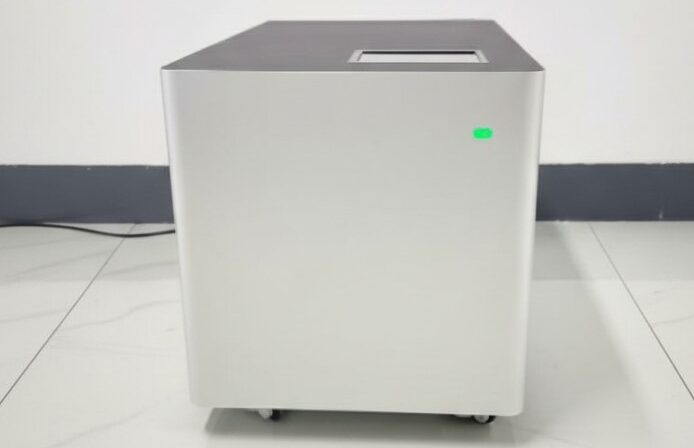
Q: What is the focus of your lab’s research?
A: One of the topics of our lab is the interaction of insect pheromones and their analogues with pheromone-binding proteins (PBPs) which are part of an extremely sensitive multi-component pheromone detection system.
We utilize binding assays to determine the function of the PBPs through affinity measurements of the protein-ligand receptors, calculate binding constants, the spatial arrangement of the complex and do modeling. In addition, point-mutated PBPs are used for a better understanding of the contribution of individual amino acids to the binding event.
Q: How does the TriVersa NanoMate® (TVNM) align with your research goals?
A: The TVNM enabled us to develop a high-throughput method to study protein-ligand-interactions for large series of different pheromones and their analogues.
As the binding energies involved are very low and we need to preserve the native structure of the molecules, the soft-ionization conditions of the TVNM are perfect for us. Further, these studies are difficult with classic electrospray, due to the stickiness of the samples. They create problems from short cleaning cycles and produce contaminations.
In contrast, the established method with the TVNM is reliable and stable, and it eliminates the sticky sample issues. In addition, multiple experiments with very low quantities of protein (1 nmol) at different cone-voltage conditions are possible.
We recently added the LESA™ (Liquid Extraction Surface Analysis) capability to the TVNM. This enables us to detect putative signal molecules on leaf surfaces and to track down their production and storage sites by comparing the data with extracts from samples derived from the inner compartments of the leaves.
Q: To whom would you recommend the TriVersa NanoMate for their research?
A: I would recommend the TriVersa NanoMate to everybody because it is a universal source. With direct infusion, coupling for fraction collection and surface analysis, it may replace all ionization sources.
More analytes and higher sensitivity
Developed in collaboration with Oak Ridge National Laboratory*, the liquid extraction surface analysis (LESA) capability of the TriVersa Nanomate® enables simple, direct ESI mass spectrometric analysis from a variety of surfaces.
In many cases of routine protein identification, processing times become the major bottleneck at the core facility. Although a nano-LC/MS/MS approach is recognized as a general strategy for protein identification, the typical 30-120 min run-time prohibits fast turnaround times. The TriVersa NanoMate offers a more rapid approach for the infusion of the protein digest, with only a 2-5 min run-time per sample.
Presented by: Ljiljana Paša-Tolić, Ph.D., Environmental Molecular Sciences Laboratory, Pacific Northwest National Laboratory
Description: Obtaining extended sequence coverage of intact proteins and characterizing multiple post-translational modification (PTM) sites can pose key technical challenges. In this webinar, we describe how we have implemented Advion’s TriVersa NanoMate® and RePlay® technologies to address these issues using an integrated top-down/bottom-up approach.
We demonstrate how the TriVersa NanoMate’s capabilities of chip-based electrospray ionization (ESI) and fraction collection are used to profile isoforms, further investigate targeted proteins at the intact level using ECD or CID, perform bottom-up proteomics on a collected fraction to get confident protein identifications, perform targeted MS/MS on particular fractions of interest, and better characterize where PTMs may have occurred.
We also discuss how RePlay simplifies the data analysis process by allowing you to see the correlation between the intact protein and the observed peptides, even when you are sample limited. Using RePlay, we incorporated an on-line digestion strategy with the integrated top-down/bottom-up approach. This technique allows you to implement LC-MS/MS during both the intact run and a secondary RePlay run with digestion, so you can see the correlation in time between the observed parent ions and the digested ions as well as the MS/MS of the fragment ions.
Martin NJ, Bunch J, Cooper HJ J Am Soc Mass Spectrom. 2013 Aug;24(8):1242-9
M. Wisztorski; B. Fatou; J. Franck; A. Desmons; I. Farre; E. Leblanc; I. Fournier; M. Salzet Proteomics Clin. Appl. 2013, 7, 1-7
Cubrilovic, D.; Biela, A.; Sielaff, F.; Steinmetzer, T.; Klebe, G.; Zenobi, R.
J Am Soc Mass Spectrom. 2012 Oct;23(10):1768-77. Epub 2012 Aug 7
Edwards, R.L.; Griffiths, P.; Bunch, J.; Cooper, H.J.
J Am Soc Mass Spectrom. 2012 Nov;23(11):1921-30. doi: 10.1007/s13361-012-0477-9. Epub 2012 Sep 20.
Annalisa Arcella, Guillem Portella, Maria Luz Ruiz, Ramon Eritja, Marta Vilaseca, Valérie Gabelica, and Modesto Orozco
Journal of the American Chemical Society 2012 134 (15), 6596-6606
Carles Bonet-Costa, Marta Vilaseca, Claudio Diema, Olivera Vujatovic, Alejandro Vaquero, Núria Omeñaca, Lucía Castejón, Jordi Bernués, Ernest Giralt, Fernando Azorín
Journal of Proteomics, Available online 27 May 2012, ISSN 1874-3919, 10.1016/j.jprot.2012.05.034.