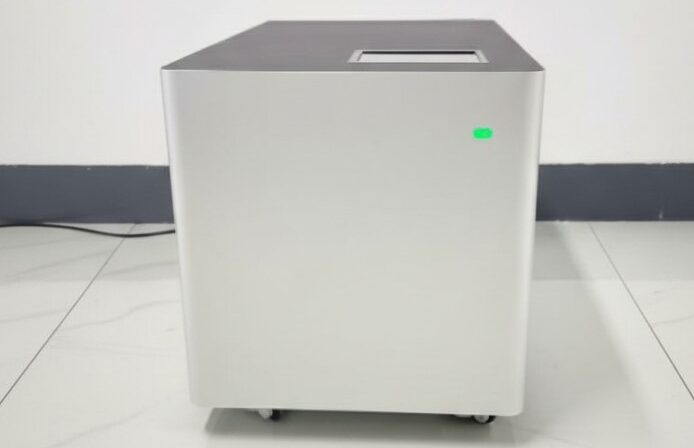
OVERVIEW
- Toluene-assisted APCI (TAPCI) can generate (M)+· and (M+H)+ ions from analytes that cannot be ionized by ESI or APCI.
- Elemental formula prediction at 250 ppm accuracy and isotope distribution matching by TAMI (Tal Aviv Molecule Identifier) supports analyte identification.
- Combining both TAPCI and TAMI on the expression compact mass spectrometer (CMS) provides a cost-effective analysis platform for a wide range of compounds.
INTRODUCTION
Many compounds in organic synthetic chemistry either have no functional group, a C=O carbonyl group, or protected functional groups and are difficult to ionize by ESI or APCI for detection by mass spectrometry. TAPCI has been shown to ionize compounds to (M)+· and (M+H)+ protonated molecules not accessible by ESI or APCI MS analysis. The ionization is believed to include a charge transfer reaction in the APCI plasma region of the source. Elemental formula prediction using TAMI allows analyte identification on a single quadrupole mass spectrometer with mass accuracy in the 250 ppm range, isotope pattern analysis and auto comparison to NIST databases. Here, we investigate the use of both techniques on the expression CMS as an attractive and cost-effective solution for analyte identification covering an increased compound space.
Quick and easy analysis methods for drugs of abuse are in high demand from health practitioners and law enforcement agencies on a global scale. In 2017, it was found that fentanyl, a fast-acting synthetic painkiller that is nearly 100 times stronger than morphine, has become the most widely abused synthetic opioid medicine – to the point it has become a public health problem. In this application note, a simple method for fentanyl screening in urine is introduced, using Advion Interchim Scientific’s Touch Express™ Open Port Sampling Interface (OPSI) coupled with the expressionL Compact Mass Spectrometer (CMS).
OPSI was developed by Gary Van Berkel and Vilnos Kertesz of Oak Ridge National Laboratory. Paired with the electrospray ionization (ESI) source of the CMS, Touch Express™ OPSI offers a fast assay benchtop solution in a small-footprint, easy-to-use system.
Introduction
Cortisol is an important steroid hormone produced from cholesterol in the adrenal cortex. Its secretion is closely regulated by Adrenocorticotropic hormone (ACTH). Most cortisol is protein-bound, and only unbound cortisol is excreted in urine. Measurement of cortisol in urine is typically used in the diagnosis of Cushing’s syndrome, a disorder of hypercortisolism.
Although immunoassay methods have extremely high sensitivity, they are subject to variable interferences from other steroids and their conjugates. Liquid chromatography with tandem mass spectrometry is increasingly used in clinical analysis because of its higher specificity and selectivity than immunoassay methods. A simple and robust UHPLC/MS method will be introduced for urinary cortisol analysis and the dynamic range and sensitivity (LOD and LLOQ) of the UHPLC/CMS method will be evaluated.
Introduction
Fentanyl, a fast-acting synthetic painkiller about 100 times stronger than morphine, is also the most widely used synthetic opioid medicine in 2017.1 Its abuse is becoming a public health problem. A quick and easy analysis method for this drug is in high demand from health practitioners and law enforcement agencies.
The Touch Express™ Open Port Sampling Interface (OPSI),2,3 is designed for simple sampling of solids, liquids, sample preparation tips and fibers. Paired with the ESI of the expression® CMS, the product incorporates an open port of continuous low-volume solvent, flowing directly into the ESI for MS analysis. Any soluble sample touching the open port will be analyzed by the mass spectrometer in just seconds.
Here, a simple and quick analysis method for fentanyl in urine using Touch Express™ OPSI on the Advion expression® CMS is presented.
Introduction
The legalization of marijuana and hemp provides commercial opportunities as well as analytical challenges. Accurate and precise quantitative analysis of plant and medicinal products is needed in this new industry to document composition and assure the safety of cannabis products. LC/MS techniques can provide unparalleled selective and sensitive measurements for these purposes. Here we describe the use of a relatively inexpensive compact mass spectrometer for SIM LC/MS analysis of cannabis-related applications.
This poster was presented at ASMS 2018 Annual Conference in San Diego, CA.
Introduction
Metal based compounds have found utility in various fields such as clinical, energy, food safety and environmental to name a few. Creating the metal complex is the last step in a synthetic process when ligands are bound to the metal center. Once made, these metal complexes can be used anywhere from stereospecific synthesis to anti-cancer drugs. It is critical that reaction conditions are providing the desired product and that side products are kept to a minimum to maximize yield. Presented here is the use of an inert atmospheric solid analysis (iASAP) probe to quickly sample and measure the reaction via mass spectrometry.
Chemical processes can be performed in two ways; in batch or in flow, each method having set advantages and disadvantages associated with them.
Flow chemistry has gathered increasing attention over the past decade and is being readily adopted into academia to help improve synthetic routes, which maybe undesirable in batch, where outputs such as yield, productivity, E-factor or selectivity maybe improved via various methods of optimisation. On-line analytics within continuous flow chemistry allow reactions to be monitored in real-time ultimately allowing immediate characterisation and the ability to optimise in the easiest possible way.
Hosted by Jack Henion, Advion’s Chief Scientific Founder, Chris Horbaczewskyj of the University of Leeds outlines the work carried out within the Bourne group for process development applications:
- Use of flow chemistry with online HPLC in the self-optimisation of reactions,
- Use of online mass spectrometry for the optimisation of continuous flow reactions using an experimental design approach,
- The development of new algorithms for multiple variable optimisation in chemical systems.
Polycyclic aromatic hydrocarbons (PAHs) are neutral compounds containing multiple aromatic fused rings that are present in fossil fuels and can be formed from the incomplete combustion of organic material. In recent years, it has been well documented that several PAHs can be potentially carcinogenic via exposure or ingestion.
In this application note, we analyze 16 PAHs by LC/CMS (EPA 610 Mix) on the EPA priority target list using the Advion expression Compact Mass Spectrometer (CMS) coupled with the Advion AVANT UHPLC system.
The Touch Express™ Open Port Sampling Interface (OPSI), is designed for simple sampling of solids, liquids and sample preparation tips and fibers. The novel ambient sampling technique was developed by Gary Van Berkel and Vilmos Kertesz, of Oak Ridge National Laboratory.
Paired with the electrospray ion source of the expression® Compact Mass Spectrometer, the product incorporates a low volume, open port of continuously swept solvent, flowing directly into the electrospray ion source of the mass spectrometer.
During this webinar you will:
- Learn how any soluble material touching the port is analyzed by the expression® Compact Mass Spectrometer in just seconds.
- Learn how the sample technique eliminates sample preparation and provides zero carry over.
- Find fast analysis methods for solids, liquids and sample preparation tips and fibers.